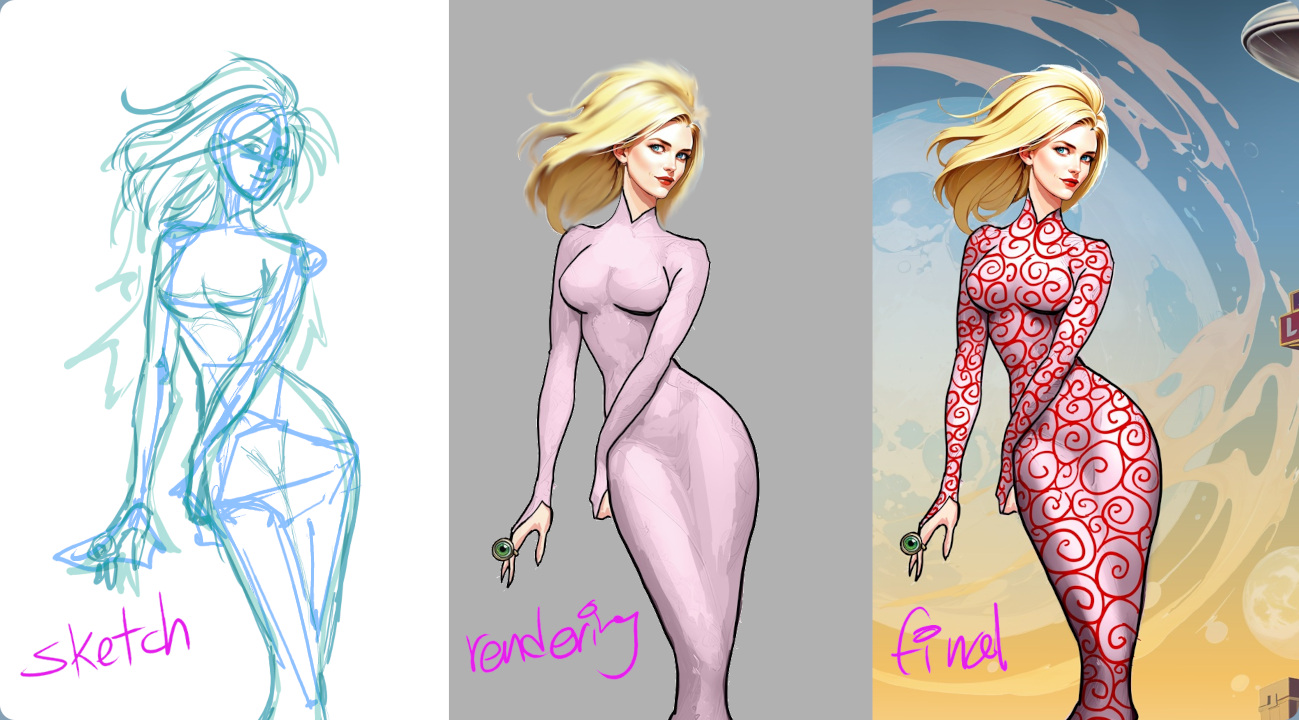
'Adopted By Appalachians' Poster
AI assisted painting using Krita & ComfyUI.
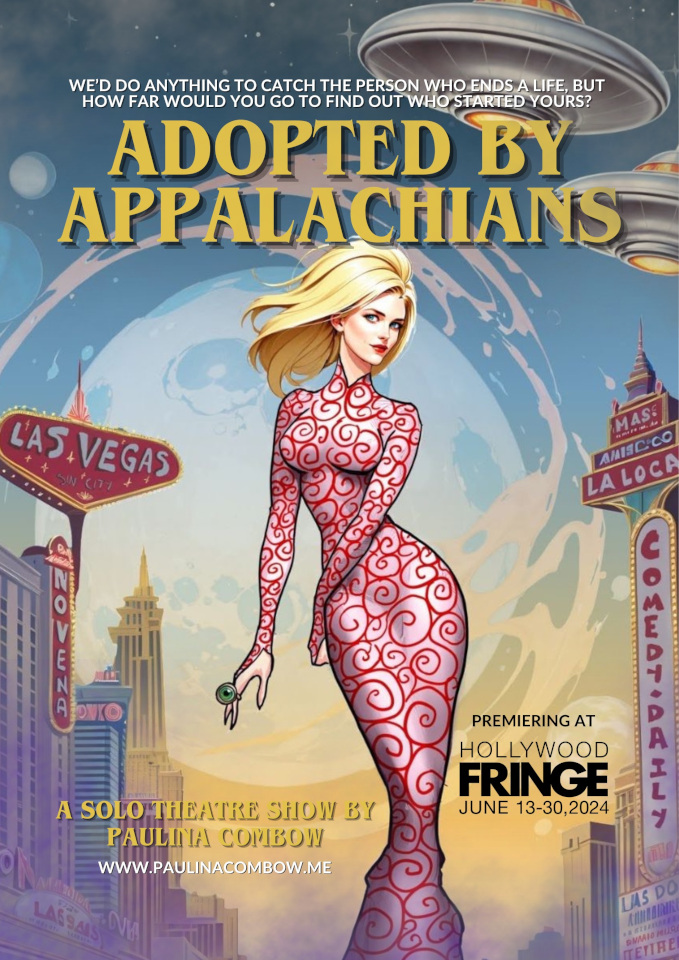
What started as an anniversary gift for my wife ended up becoming the poster for her one-woman show at Hollywood Fringe. So, it still counts as a gift, I think.
From the time we were dating, my wife and I have always made gifts for each other — custom fridge magnets, Lego portraits, you name it. We're cheesy like that. A few years back, I decided to paint a rendition of her as the Martian Spy from Mars Attacks!, one of our favorite movies. Plus, it was also the perfect excuse to test a ComfyUI Krita plugin which I'd recently come across.
Why not just train a LoRA and prompt the image? Because in the AI "dark ages" of 2024, local edit models like Qwen or Flux Klein weren't a thing yet. Even with ControlNet or image2image, I couldn't get the level of control I craved. Not to mention, I wanted to paint something for her, which is considerably more romantic than: "Hey hon, here's an image I prompted that sort of looks like what I envisioned. Happy Anniversary!" I didn't want to just accept whatever random image the model spat out. I wanted to art-direct the crap out of it to match the vision in my head. But time was running out! I may have procrastinated a bit…
If you've never painted, digitally or otherwise, I'll let you in on a little secret — painting can be fun, but it's also time consuming. Very much so. Even for professionals I've worked with during my time in Animation and VFX, a finished piece can easily take several hours of grueling work. And that's before the notes arrive, and my wife had notes.
Thus, anything that could be done to "help speed the process along" is fair game in my book. This doesn't mean the AI does everything on its own — if it did, I'd just be back in image-prompting-land. But helping me brainstorm types of buildings, iterate on a car, or quickly visualize a backdrop, then that's A-OK as far as I'm concerned.
Since I was basing this painting on the Martian Spy, I started by gathering references. The outfit and movement were iconic, but because paintings are static (outside of the Harry Potter universe, of course), I had to find the right pose. So, I started sketching while replaying that scene in the film over and over again until I found a composition I liked.
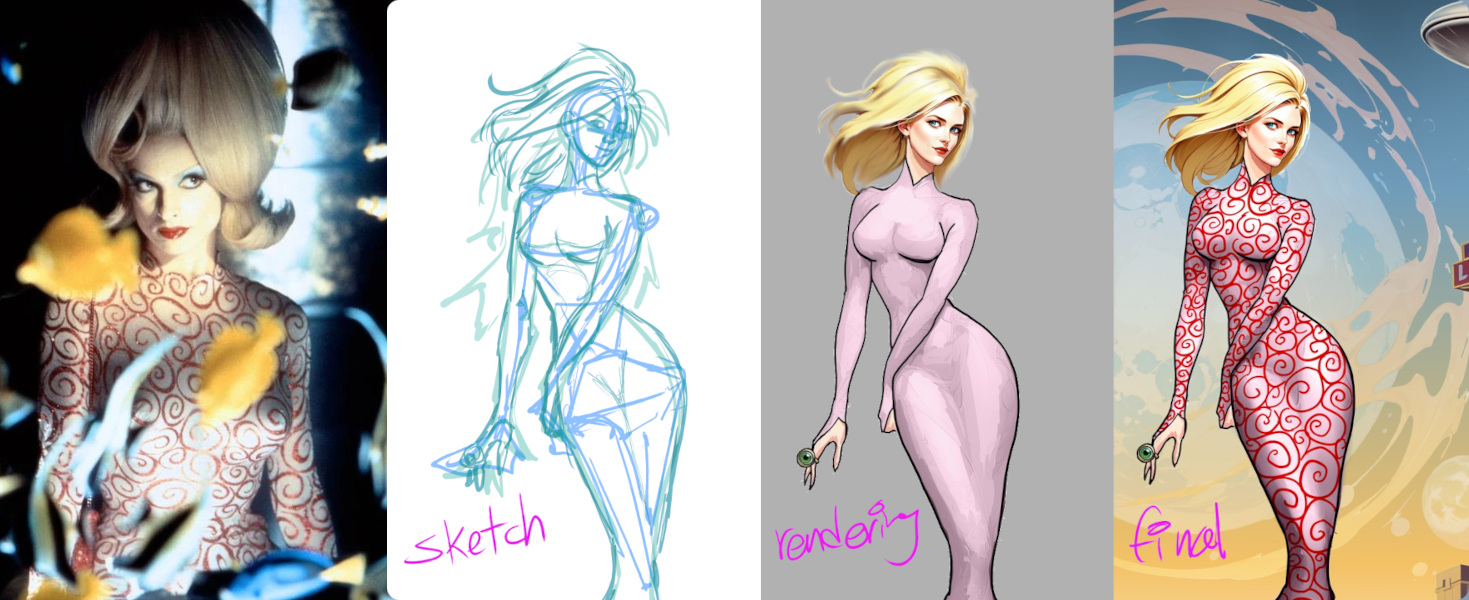
With the basic sketch complete I began clean-up and rendering, taking a bunch of lines and squiggles and turning them into my Martian Spy Wife. During this phase I used the Krita plugin to quickly visualize different styles and features, or help me with a particular detail that was driving me crazy, like hands. I hate drawing hands.
Now, you have to remember this was 2024 and there was only so much the local AI models at the time could do. So even if I'd wanted the AI model to take a more active role while still allowing me to art direct it, there's a good chance it would've just crossed its arms and said no. Or crashed my computer. A good example of this are the swirly red details on the dress. Good luck explaining to an AI model what they are and how they need to be laid out in such a way that they conform to the topology of the dress… yeah, not happening. So in the end those were a 100% manual labor of love.
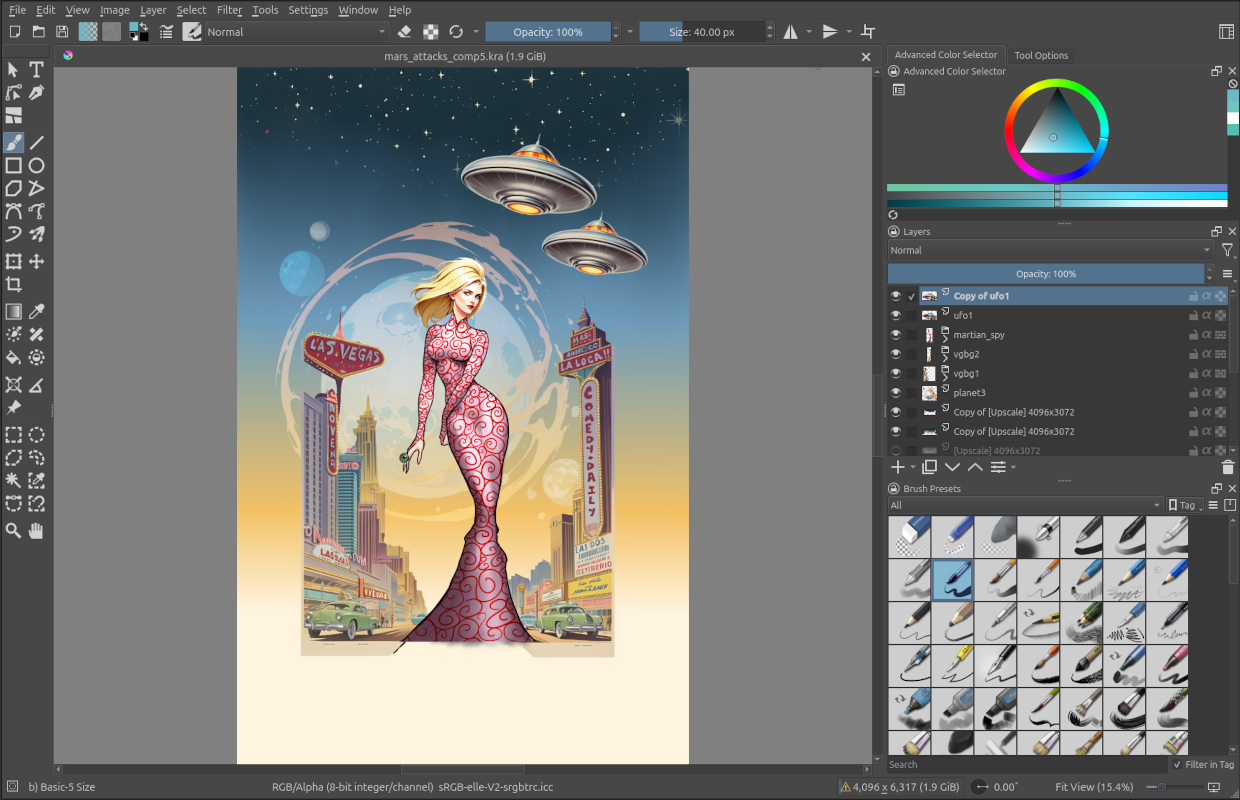
The final step was compositing the disparate elements I'd painted into a cohesive whole through the magic of layers. So many layers. While I'd envisioned the character in great detail I sorta relegated the background to "I'll get to it eventually" status. Thankfully, the plugin allowed for some much-needed rapid exploration. With my wife's input and a few more hours of work, I finally arrived at something I was happy with.
Below is what my Krita work file looked like, followed by the final movie poster:
But most important of all: my wife loved it! The fact that I ended up researching new tools and workflows and picked up a new skill was just gravy.